
Ideaforge Tech
India’s Defence Drone Leader at the Center of the UAV Shift
Before we begin, Check our Investorstack - Your one stop destination to become a better investor. Here’s Everything we Introduced Past Week:
Thematic baskets like data center proxies, CMDO, GLP-1s
New scanners including RSI breakout, VCP
Investorstack 35 (caught many stocks early using this scan)
Walk the talk analysis using past 3 years of concalls
Capex Tracker for all companies
Updated market dashboard with multiple data points
And many more features! For any feedback, reach out on Twitter.
Ideaforge builds unmanned aerial systems. In plain English, it makes drones, the control software that flies them, the payload and analytics layer that turns flight data into usable information, and the service network that keeps those drones usable in the field.
This is not a consumer drone company. Its core customer is an institution that needs a drone to work when the environment is hostile, the weather is bad, the operator is not a hobbyist, and the mission matters. The Indian Army using a Switch UAV at high altitude is a very different problem from a real estate broker taking aerial footage. The aircraft has to take off without a runway, fly long enough to be useful, carry a surveillance payload, resist jamming and spoofing, transmit usable data, return safely, and survive repeated field use.
Ideaforge was incorporated in 2007 and came out of the IIT Bombay engineering ecosystem. The company’s long-term bet has been that India would eventually need indigenous unmanned aircraft for defence, homeland security, mapping, inspection, disaster response, and logistics. For many years that was an early market. Procurement was uneven, regulations were still forming, and large demand cycles came in bursts. The company therefore built a full-stack capability instead of only assembling imported kits.
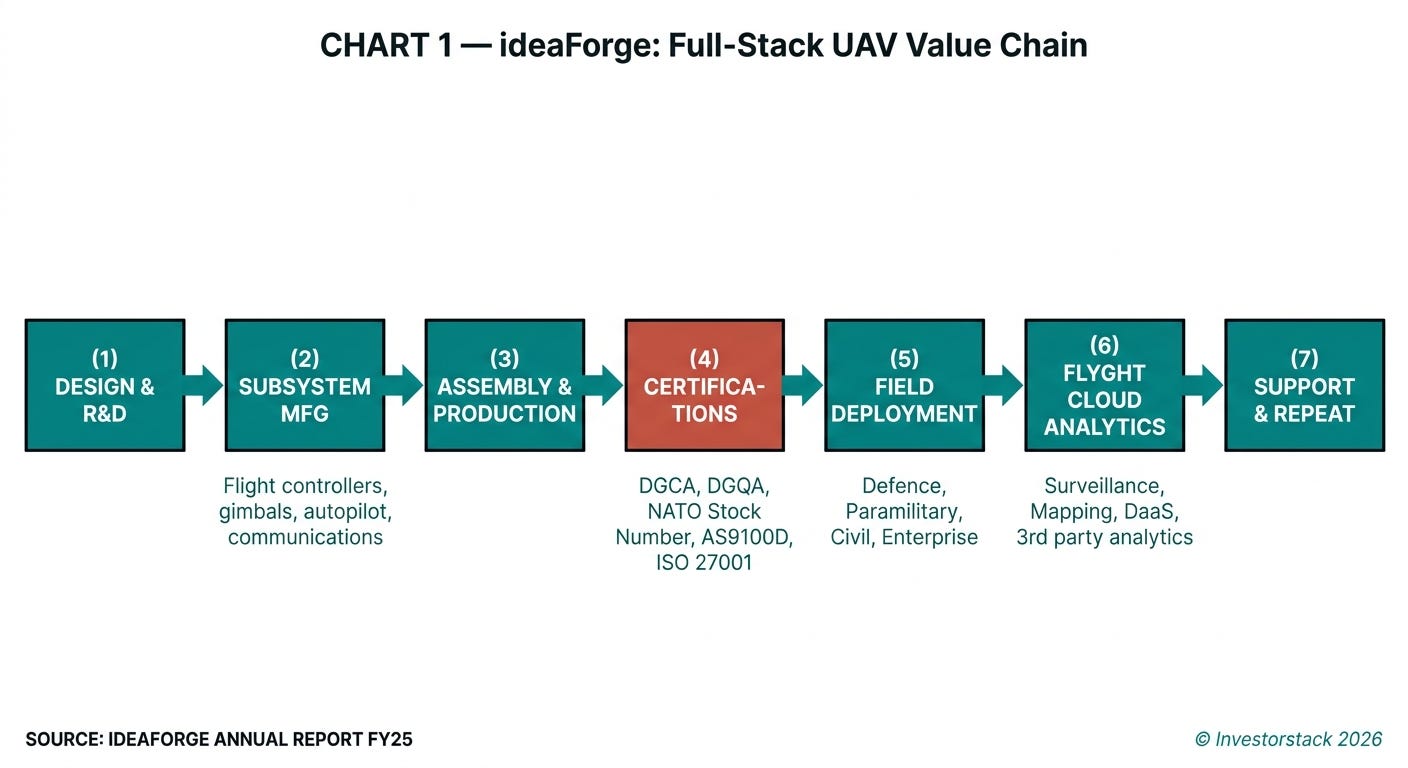
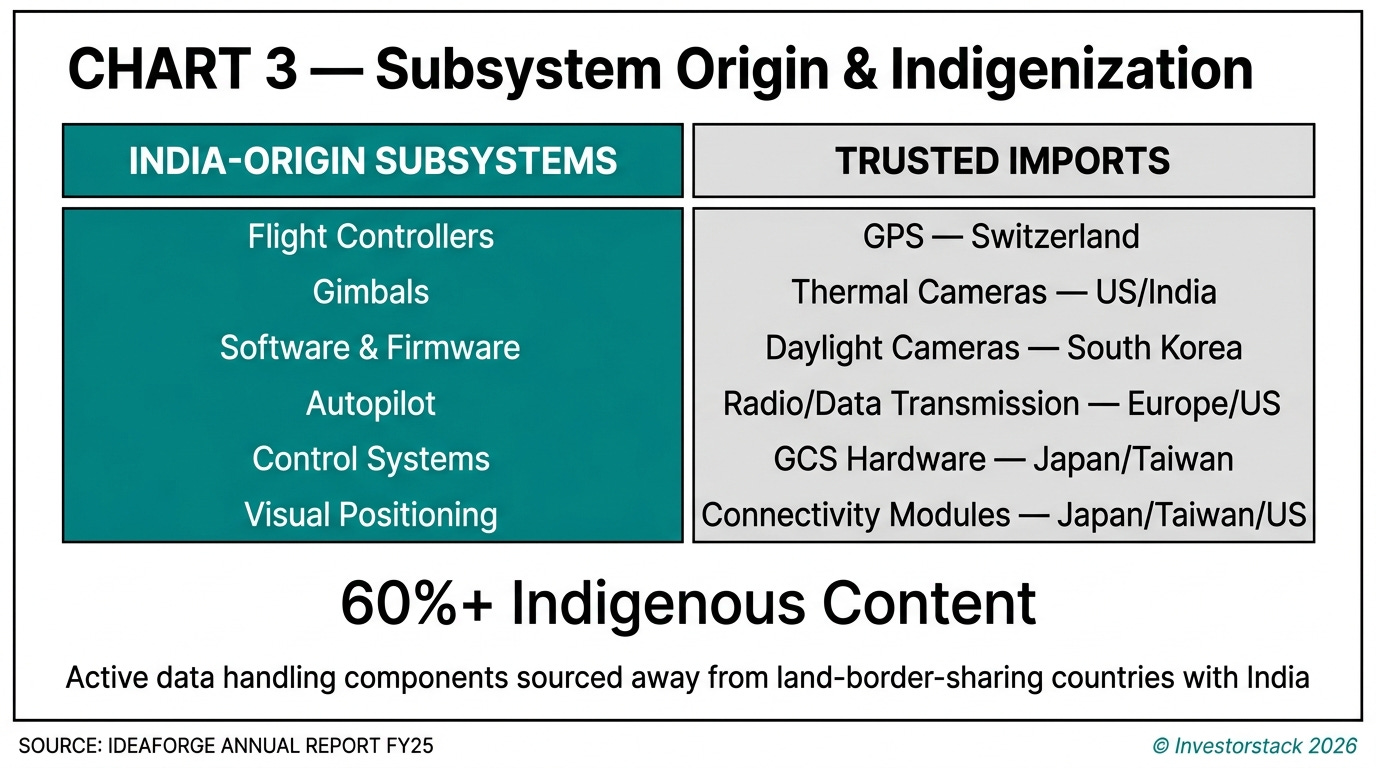
That full-stack approach is the center of the business. Ideaforge designs airframes, develops autopilot and control software, works on communications and navigation, integrates cameras and gimbals, manufactures drones in India, trains users, and provides support. The annual report states that more than 60% of its products are indigenized and that critical subsystems such as flight controllers, gimbals, software, and firmware are built around Indian or trusted supply chains.
Its products are used for intelligence, surveillance, reconnaissance, mapping, surveying, inspection, search and rescue, and emerging logistics use cases. The defence business is driven by mission need. The civil business is driven by productivity, safety, and data capture. Both depend on the same underlying capability: put a reliable autonomous aircraft into the air, collect data, and turn it into a decision.
Business segments
Operationally, the business is best understood through four activity pools: defence and homeland security UAVs, civil and enterprise UAVs, software and drone-as-a-service, and new platform programs.
Defence and homeland security UAVs
This is the strategic core of Ideaforge. The customer is usually the armed forces, paramilitary forces, police, homeland security agencies, or other government security users. The use cases are surveillance, border monitoring, tactical intelligence, search operations, disaster support, and now a gradual move toward tactical multi-role systems.
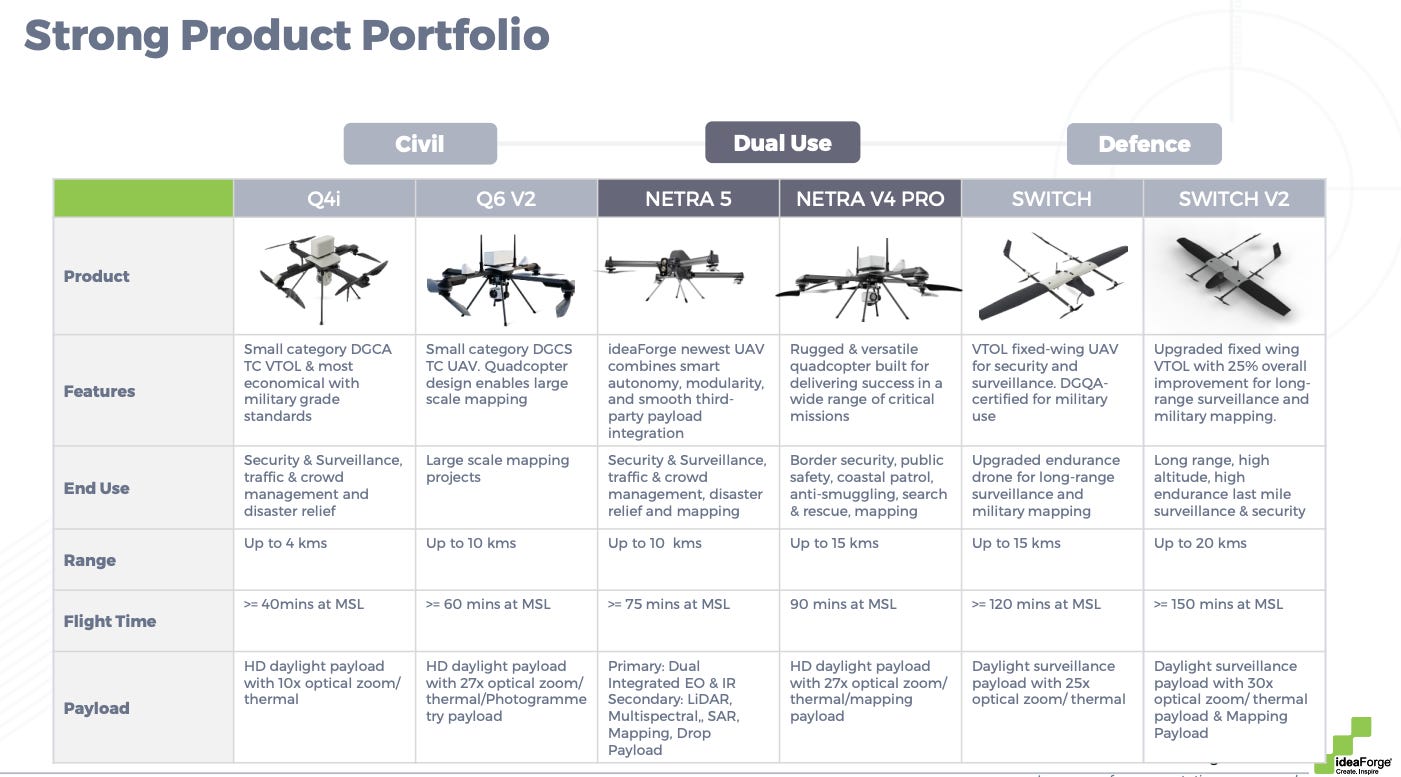
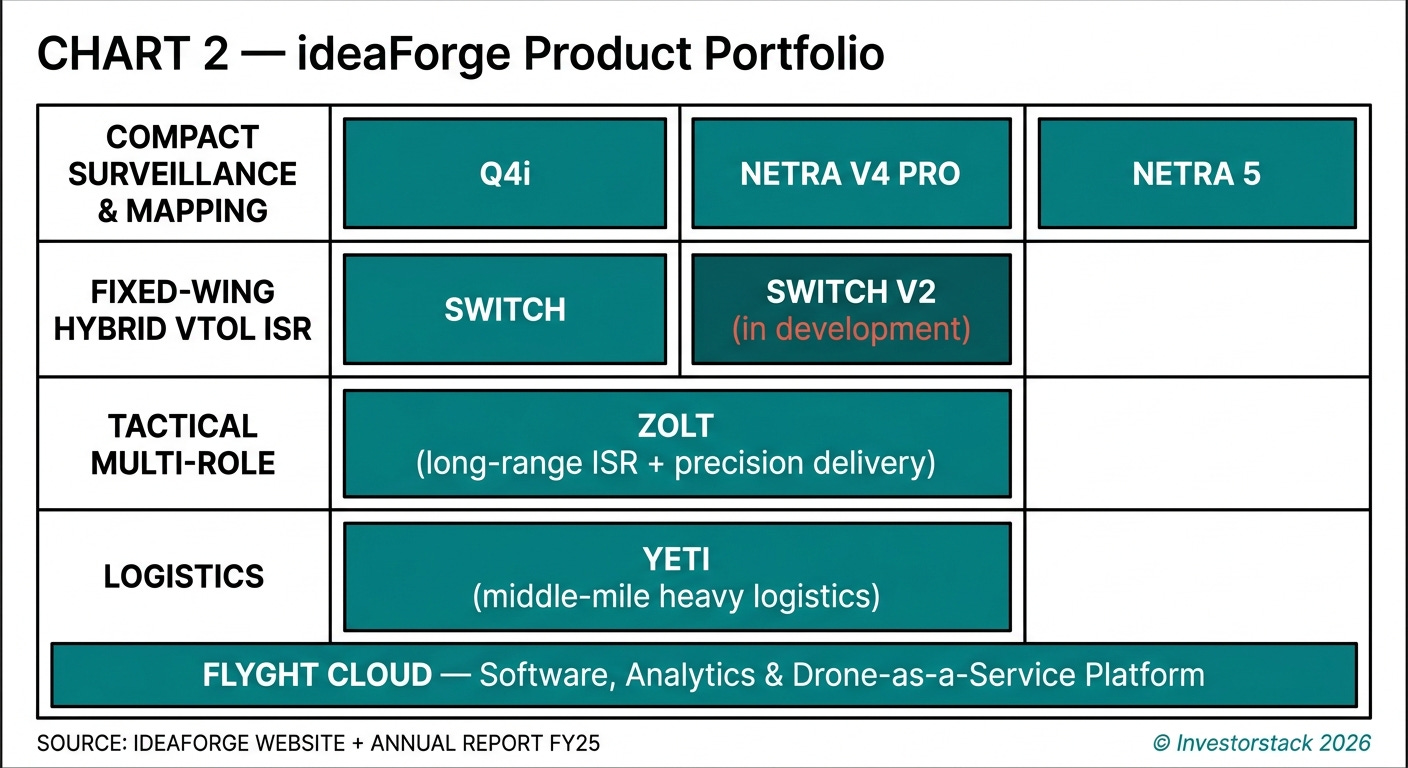
The main products here are SWITCH, SWITCH v2, NETRA, Q4i, Q6, Q6 v2 Geo, NETRA 5, and ZOLT. SWITCH is the company’s fixed-wing hybrid VTOL platform. That matters because it can take off vertically like a quadcopter but fly like a fixed-wing aircraft. For a military user operating in mountains, deserts, forests, or forward areas without prepared runways, that combination is valuable. NETRA and Q series platforms are more compact surveillance and mapping systems. ZOLT is the newer tactical UAV platform aimed at longer-range and multi-role use.
Management has repeatedly framed the defence shift around electronic warfare. After Operation Sindoor, it said the customer requirement moved from ordinary drones to drones that can operate under jamming, spoofing, degraded communications, and GNSS-denied conditions. In the Q1 FY26 concall on July 23, 2025, Ankit Mehta said the company had “identified the need for EW-resilience platforms a few years back by looking at and learning from global conflicts.” In the Q4 FY26 concall on May 4, 2026, he said EW resilience had moved from “a developmental and demonstrable capability to a deployed and inducted capability.”
That is the key distinction in this segment. Many companies can assemble a drone. Fewer can build a system that passes defence trials, works in high-altitude or hot environments, meets country-of-origin scrutiny, and gets accepted after electronic warfare testing. Ideaforge’s edge comes from having built its own communication resilience, GNSS-denied navigation, visual positioning, autopilot, and platform control stack over years.
Procurement structure is still hard. Defence buying is tender-led. The company must clear paper evaluation, field trials, quality checks, financial bids, and sometimes customer inspections before revenue can be recognized. In the Q3 FY26 concall on January 23, 2026, CFO Vipul Joshi explained that vendors are first evaluated on specifications, then invited for field trials, and only those who pass field evaluation become part of the financial bid opening. Better technology helps a company qualify, but the final award often still depends on tender terms and L1 pricing.
Civil and enterprise UAVs
Civil and enterprise UAVs use the same aircraft and software capabilities for non-combat work. The applications are mapping, surveying, disaster response, inspection, monitoring, smart forests, emergency response, power line inspection, and geospatial data capture.
The annual report says Ideaforge supplied one of the largest fleets of drones for the Government of India’s SVAMITVA scheme to map abadi areas across villages. It also says the company is the official drone data provider for Operation Dronagiri under the National Geospatial Policy 2022. These are important because civil adoption often begins with government programs. Once the state starts using drones for land records, disaster response, forest monitoring, and municipal work, the market starts to move from experimentation to regular usage.
Civil demand is not identical to defence demand. A mining company, municipality, or infrastructure operator may care more about repeatable data capture, lower total cost, ease of use, analytics, and service availability than combat survivability. This is where Ideaforge’s flight history helps. The website says customer flights have crossed 950,000 and that one Ideaforge drone takes off every three minutes. Every field flight gives the company data on user workflows, weather, failures, maintenance, mission planning, and training gaps.
Civil sales also reduce concentration risk. The annual report shows that the mix moved from heavily defence-led in FY22 to a more balanced defence-civil split in FY25. That does not mean civil can replace defence in the near term. It means the company is trying to make the business less dependent on one ministry’s procurement calendar.
Software, analytics, and drone-as-a-service
Flyght Cloud is Ideaforge’s software and analytics layer. The company describes it as an integrated UAV data analytics platform that helps users move from flight to foresight. The simple idea is this: a drone flight is not useful by itself. The user needs a map, an alert, a measurement, an inspection finding, a surveillance workflow, or a decision. Flyght Cloud is meant to host those workflows and integrate third-party analytics plugins.
This is strategically important because hardware sales are lumpy. Defence orders come in cycles. Civil customers may hesitate to buy fleets upfront. Software and drone-as-a-service could convert some usage into repeatable deployments. In the Q3 FY26 concall, management said civil and enterprise customers are increasingly looking for outcomes, not just hardware, and that Flyght Cloud can become a stabilizer alongside defence.
Drone-as-a-service is the other part of this segment. Instead of buying a drone and maintaining operators, a customer pays for flight output or service availability. Ideaforge calls this a way to replace upfront drone acquisition and operating cost with a pay-per-flight model. This is not yet the dominant business model, but it matters because it could open customers who need aerial data but do not want to own drone operations.
New platform programs: ZOLT, YETI, combat drones, and logistics
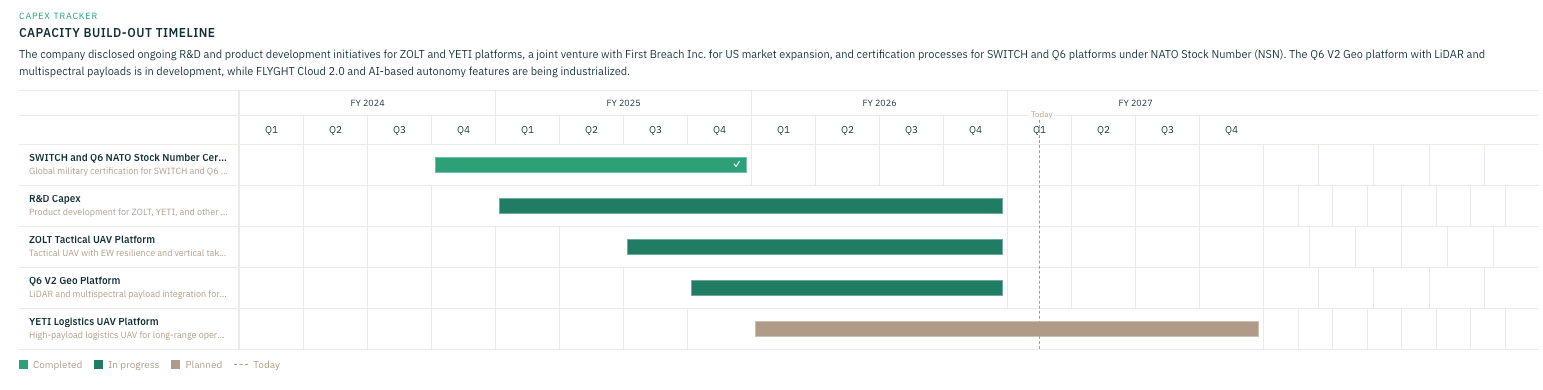
ZOLT and YETI are the main new platform programs. ZOLT is a tactical multi-role UAV. Management says it is intended for long-range ISR and precision payload delivery. In the Q1 FY26 concall, the company said it was building multiple UAVs for testing and prototype readiness review for Make-II opportunities for ZOLT. By Q3 FY26, ZOLT had already won emergency procurement orders, which suggests that the platform moved from development into customer validation faster than a normal peacetime product cycle might have allowed.
YETI is the logistics platform. Rahul Singh described it in the Q4 FY26 concall as a middle-mile logistics platform, first targeted at military high-altitude heavy logistics and eventually commercial logistics. This is a different problem from surveillance. Surveillance drones optimize endurance, sensor quality, range, and stability. Logistics drones optimize payload, reliability, route safety, energy density, and mission economics. The first market is likely defence because high-altitude resupply is painful, dangerous, and expensive.
Combat drones are the adjacency. Management has been careful here. Ideaforge does not present itself as a munitions company. It says it will partner with players that already handle munitions and will bring its aerial robotics, autonomy, and integration stack. In the Q4 FY26 concall, Ankit Mehta said combat capabilities would be built through a combination of in-house development and partnerships, including long-range strike platforms, loitering munitions, and kamikaze systems. The logic is that ISR drones find targets, and strike drones act on that intelligence. If the customer wants an integrated drone architecture, the ISR provider has a natural seat at the table.
Products and business detail
Ideaforge’s product catalogue spans fixed-wing hybrid VTOL, quadcopters, tactical UAVs, logistics UAVs, software, payloads, and service offerings.
SWITCH is the flagship fixed-wing hybrid VTOL surveillance platform. Fixed-wing flight gives endurance and range. Vertical take-off and landing removes the need for runway infrastructure. This is why SWITCH became important for military use. The company says SWITCH is certified and accredited by both civil regulators such as DGCA and military agencies such as DGQA and NATO codification. Management also said in the Q1 FY26 concall that SWITCH has the highest deployment with the armed forces in its category and is the only platform with fit for Indian military use certification.
SWITCH v2 is the next-generation version. Management said in Q1 FY26 that SWITCH v2 was undergoing final evaluations before pilot production. The point of a next-generation platform is not simply to refresh the model. Defence drone requirements keep changing. Range, endurance, payload, electronic warfare resistance, onboard compute, and autonomy all have to improve because counter-drone systems and battlefield expectations are improving.
NETRA, NETRA v4 Pro, and NETRA 5 are multirole surveillance platforms. NETRA 5 was highlighted at Aero India 2025 and is in the final stages of industrialization according to the Q1 FY26 concall. These platforms address shorter-range, mobile, and tactical surveillance needs where portability, reliability, and mission readiness matter.
Q4i, Q6, Q6 v2, and Q6 v2 Geo serve mapping, surveillance, and geospatial use cases. Q6 received NATO stock number recognition after SWITCH, making both platforms eligible for inclusion in NATO and allied procurement systems. Q6 v2 Geo is aimed at mapping and geospatial applications. These products matter for civil government schemes, survey work, land mapping, and infrastructure inspection.
ZOLT is the tactical UAV platform. It sits above the compact surveillance drones and is meant for longer-range ISR, multi-role operations, and precision payload delivery. Management repeatedly links ZOLT to Make-II and post-operation Sindoor demand. ZOLT is important because it expands Ideaforge’s addressable market from surveillance into tactical operations.
YETI is the middle-mile logistics UAV. Management expects the first use case to be military high-altitude heavy logistics. If a forward post needs supplies where roads are poor, weather is difficult, and helicopters are expensive or unavailable, a logistics UAV becomes useful. The harder part is proving reliability, payload economics, and safety at scale.
Flyght Cloud is the software platform. It supports data workflows, analytics, surveillance, mapping, and third-party analytics plugins. BlueFire Touch is the ground control interface for mission planning and drone control. The SWITCH product page highlights features such as take-off area checks, custom maps, mission replay, and real-time annotation. Those features sound small, but they matter in field use. A non-expert operator needs to plan missions around terrain, mark points of interest, share coordinates, and review flight paths without treating every flight like an engineering exercise.
Manufacturing is based in India. The registered office and manufacturing location is at Mahape, Navi Mumbai. The annual report also refers to a new manufacturing facility in Bengaluru. The company says its manufacturing facilities use semi-automated systems and quality management standards for UAV design and manufacturing. Certifications include AS9100D for aerospace quality management and ISO 27001:2022 for information security.
Supply chain control is a central business detail. The annual report lists flight controllers as India-origin, gimbals as India-origin, software as India-origin, thermal cameras from the US or India, daylight cameras from South Korea, GPS from Switzerland, and other electronics from Japan, Taiwan, the US, Europe, and South Korea. This is not 100% indigenization, but it is not a black-box import model either. For defence customers, transparency of origin and avoidance of countries of concern are part of the product.
Customers
Ideaforge sells to defence forces, paramilitary forces, police and homeland security agencies, government departments, state governments, municipal bodies, infrastructure users, geospatial customers, and private enterprises.
Named public customer references include the Indian Armed Forces, police departments, disaster response agencies, government programs such as SVAMITVA, and Operation Dronagiri. The competitor article also lists Indian Army, CRPF, NSG, and L&T as clients. The company’s US order from Lamar Police Department in Texas is its first disclosed order in that geography. It will support student safety across a school district.
Defence customers buy after evaluation, not after a sales demo. The process begins with RFP specifications, then technical paper checks, then field trials, then financial bid opening, then inspections, QA review, delivery, and acceptance. Vipul Joshi explained in the Q3 FY26 concall that any vendor unable to qualify in field trials is not part of financial bid opening. This means the product must first clear technical gates before price decides the outcome.
Switching costs come from qualification, training, mission procedures, installed support, field familiarity, and procurement risk. Once a unit has trained operators on a platform, integrated the drone into mission workflows, and accepted its performance under real conditions, replacing it is not trivial. But this is not a software lock-in business. If a competitor clears trials with a lower price and acceptable capability, the tender structure can still move business away.
Partner-led channels matter for state-level and civil opportunities. In the Q3 FY26 concall, management said partners can act as lead bidders and help with execution, support, training, and local penetration. Payment terms depend on contracts, but partner arrangements often mirror end-customer structures when advances are involved. This lets Ideaforge reach more local tenders without building a large direct sales presence in every geography.
Customer concentration risk remains real because defence orders are large and lumpy. The company can win a major emergency procurement order and then face a weak quarter while awaiting inspections, acceptance, or the next tender. Civil, software, and drone-as-a-service are meant to smooth this over time, but as of the latest concalls, defence remains the bigger near-term demand driver.
Competitive landscape
Ideaforge competes in a crowded but segmented drone market. The competitor set changes by use case.
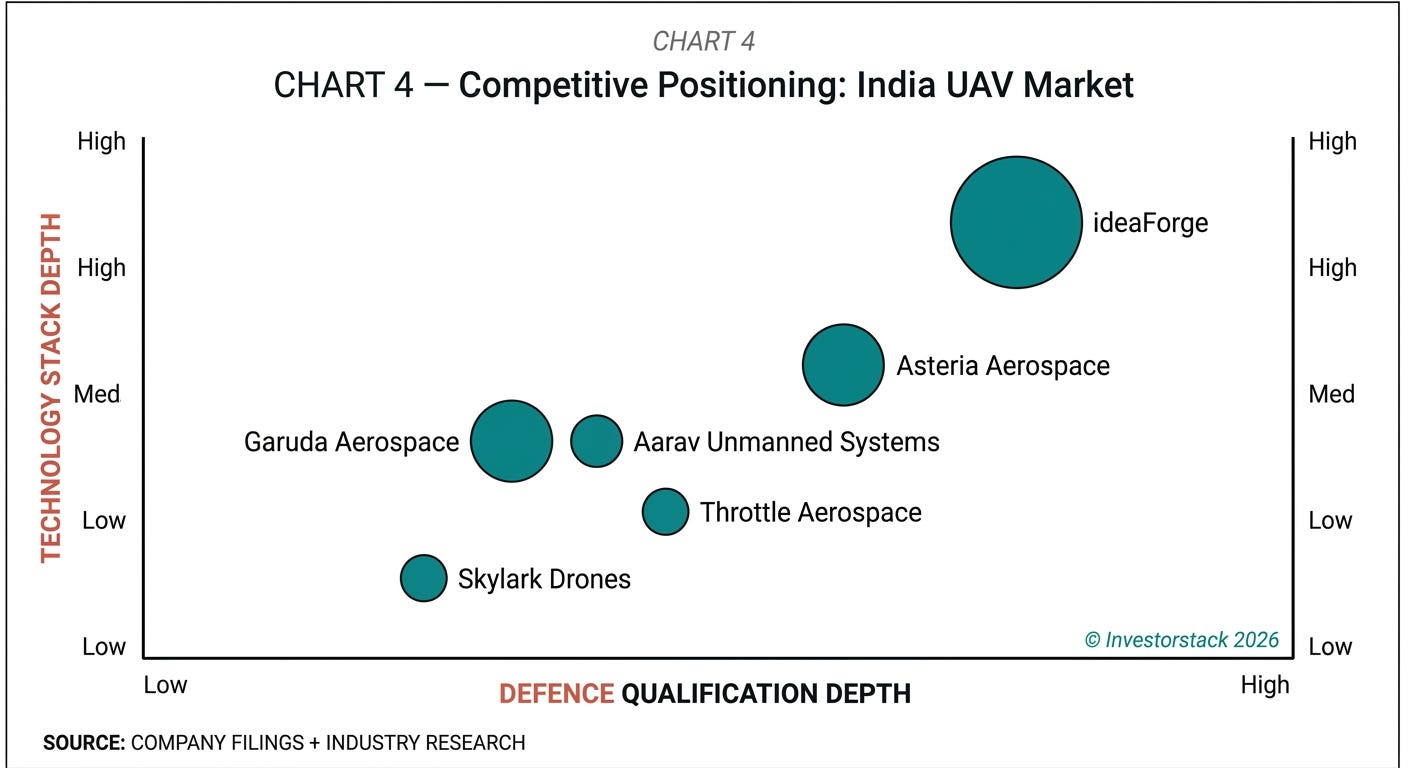
In defence and homeland security, the real competition is not only other listed companies. It includes Indian drone manufacturers, start-ups, defence electronics players, global drone suppliers, and system integrators that can bid into government tenders. Named Indian competitors and adjacent players include Garuda Aerospace, Asteria Aerospace, Aarav Unmanned Systems, Throttle Aerospace Systems, Skylark Drones, NewSpace Research and Technologies, and other specialized drone and defence start-ups. Global competition includes foreign UAV makers where procurement rules allow imports or partnerships.
Garuda Aerospace is strong in drone-as-a-service, agriculture, and multi-application drone operations. Asteria Aerospace, backed by Jio Platforms, is a full-stack drone and AI company focused on surveillance, inspection, and data intelligence. Aarav Unmanned Systems is strong in surveying and mapping. Throttle Aerospace has logistics, inspection, and BVLOS experience. Skylark is more analytics and drone data focused. NewSpace Research is relevant in advanced defence and solar or high-endurance drone categories.
Ideaforge wins when the requirement demands defence-grade reliability, indigenous control, high-altitude operation, VTOL plus endurance, EW resilience, and field-proven deployments. Its strongest argument is not that it is cheaper. It is that its systems have already been used in difficult conditions and that it controls more of the technology stack than an assembler.
It can lose when tenders prioritize L1 price after technical qualification, when competitors offer simpler systems that are good enough, when a niche product requirement sits outside its portfolio, or when global players bring mature capabilities through local partners. Management itself acknowledged in the Q3 FY26 concall that additional capabilities do not automatically win the order unless the contract gives enhanced performance parameters a pricing advantage.
Barriers to entry are high in defence-grade UAVs but lower in basic drones. Making a quadcopter fly is not hard. Making a drone work under jamming, carry mission payloads, pass country-of-origin checks, survive high altitude and extreme weather, integrate into defence procurement, support field units, and maintain data security is harder. The market therefore has many entrants but fewer credible defence suppliers.
Industry
The Indian drone industry is moving from demonstration to procurement. The early narrative was about drones as gadgets. The current narrative is about drones as security, geospatial, inspection, emergency response, and logistics infrastructure.
Three demand drivers matter most. First, defence demand has accelerated after recent conflicts showed how drones, electronic warfare, and counter-drone systems shape modern battlefields. Management repeatedly referred to Operation Sindoor as a validation that drones are central to modern defence and that EW-resilient platforms are no longer optional.
Second, government policy is pushing domestic supply. The Q2 FY26 concall discussed Defence Procurement Manual 2025, where global tenders below certain thresholds are off by default, audited local content is required for large orders, and e-procurement processes are emphasized. This tilts the market toward Indian companies with genuine local technology and supply chain transparency.
Third, civil use cases are widening. Land mapping, power line inspection, disaster response, smart forests, municipal surveillance, infrastructure monitoring, and enterprise security all benefit from aerial data. Civil demand usually takes longer because customers need workflows and proof of economics, not just aircraft. That is why Flyght Cloud and drone-as-a-service matter.
The global context also helps and hurts. Global conflicts increase demand for drones and EW resilience. They also strain supply chains for thermal imagers, sensors, communications modules, and specialized electronics. In the Q4 FY26 concall, Ankit Mehta specifically called thermal imagers a constrained area for everyone because of global supply-chain conditions.
Import dynamics are changing. Indian customers are increasingly sensitive to country-of-origin, IP integrity, and trusted subsystems. Ideaforge’s annual report says active data handling components and critical subsystems are kept away from geographies of concern or land-border-sharing countries with India. That matters because a defence drone is also a data and security product.
Growth triggers
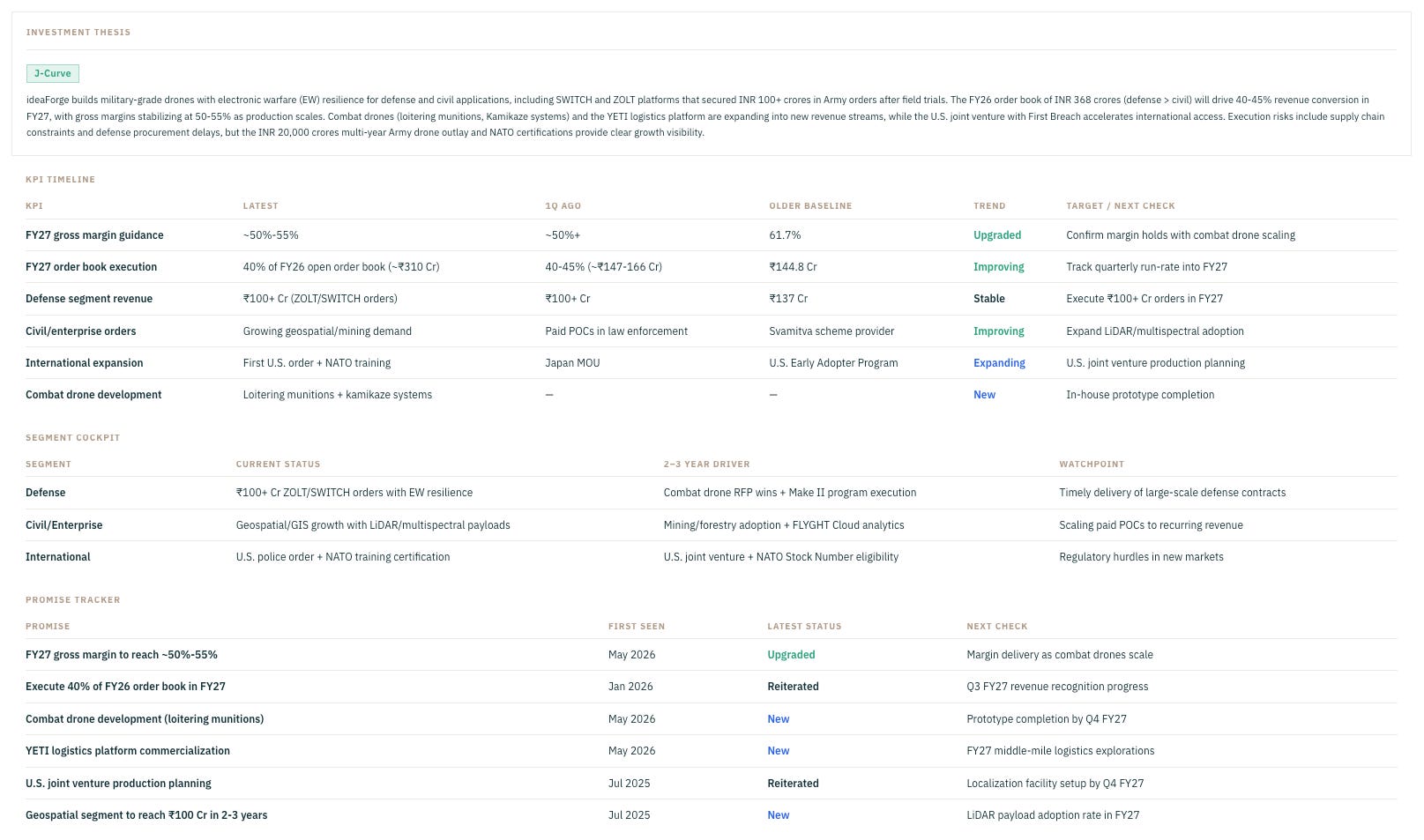
Execution of the carry-forward order book in FY27. In the Q4 FY26 concall, Ankit Mehta said the open order book at the start of FY27 was slated for execution within FY27, and later clarified that the first three quarters were the expected conversion window for the carry-forward order book.
Larger Indian armed forces procurement cycle. In the Q4 FY26 concall, Ankit Mehta said there were indications of a very large buying cycle from the Indian armed forces and that certain approvals had happened in the Defence Production Board for some opportunities.
EW-resilient systems becoming a baseline requirement. In the Q3 FY26 concall, management said electronic warfare resilience had shifted from a wish-list item to a baseline requirement and that this shift was translating into procurement decisions.
ZOLT moving from development into demand, Ankit Mehta said ZOLT had been built after seeing demand signals and that, when the opportunity came after Operation Sindoor, the platform could be demonstrated and garner orders.
YETI logistics platform development. In the Q4 FY26 concall, Rahul Singh said YETI is focused on middle-mile logistics, beginning with military high-altitude heavy logistics and eventually commercial logistics at scale.
International expansion through the United States. Management said Ideaforge received its first US order from Lamar Police Department in Texas, trained NATO forces at the US National Test Pilot School, demonstrated products to US Department of Defence customers in Alaska, and was progressing its first Breach joint venture.
Japan partnership for AI drones. In the Q4 FY26 concall, management said Ideaforge signed a strategic MOU with Digital Media Professionals Inc. in Japan to enter Japan and develop next-generation AI drones.
Flyght Cloud and drone-as-a-service adoption. In the Q3 FY26 concall, management said civil and enterprise customers are increasingly looking for outcomes rather than hardware and that Flyght Cloud can become a stabilizer alongside defence.
Key risks
Defence procurement lumpiness. Ideaforge can have the right product and still wait for tenders, trials, inspections, QA reviews, and budget approvals. This creates gaps between order visibility, delivery, acceptance, and revenue recognition. The mechanism is simple: fixed costs continue while procurement timing moves in bursts.
L1 tender pressure. Field performance matters, but many tenders still move to financial bid after technical qualification. If several vendors pass the technical gate, the lowest bidder can win. Ideaforge’s higher capability only protects it when the specification demands that capability or the tender assigns value to enhanced performance.
Supply-chain constraints in critical subsystems. Thermal imagers, communication components, sensors, and trusted electronics can become bottlenecks during global conflict or export tightening. If one subsystem is delayed, a finished drone cannot be delivered. Management specifically flagged thermal imagers as constrained in the Q4 FY26 concall.
Technology race against counter-drone systems. Drones are operating in an arms race. Soft-kill jamming, spoofing, GNSS denial, directed energy, microwave systems, and hard-kill interceptors keep improving. Ideaforge has invested in EW resilience, visual positioning, CRPA antennas, and communication resilience, but there is no permanent solution in this industry.
Overextension into too many adjacencies. ZOLT, YETI, combat drones, international localization, Flyght Cloud, drone-as-a-service, AI, and civil enterprise opportunities all require management attention and capital. The risk is not that these markets are unattractive. The risk is that too many simultaneous bets dilute execution.
International localization and regulatory risk. The US and NATO opportunity is attractive but slow. Defence customers in those geographies require local presence, certifications, regulatory compliance, trusted supply chains, and long qualification cycles. A US joint venture improves the pathway but does not guarantee conversion.
Civil adoption may take longer than management expects. Enterprises often like drone demonstrations but hesitate to change workflows. The customer must budget for operations, data handling, training, liability, and integration. If Flyght Cloud and drone-as-a-service do not solve those adoption frictions, civil demand remains uneven.
Walk the talk
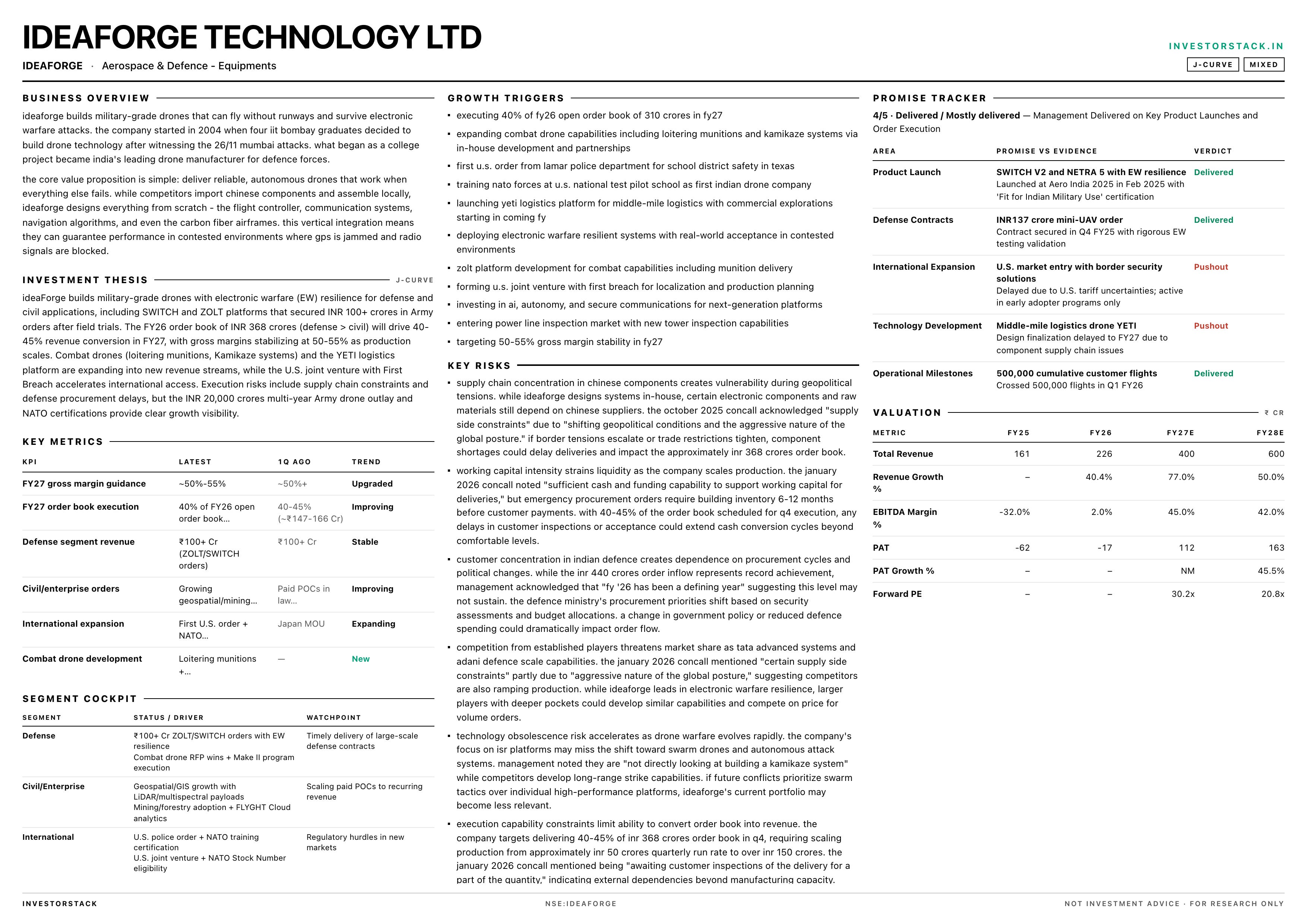
4/5. Management Delivered on Key Product Launches and Order Execution
Ideaforge demonstrated strong credibility by delivering on critical product launches like SWITCH V2 and ZOLT, securing large defense contracts, and achieving operational milestones. However, international market expansion faced delays due to geopolitical and regulatory challenges.

Scenarios & Valuation
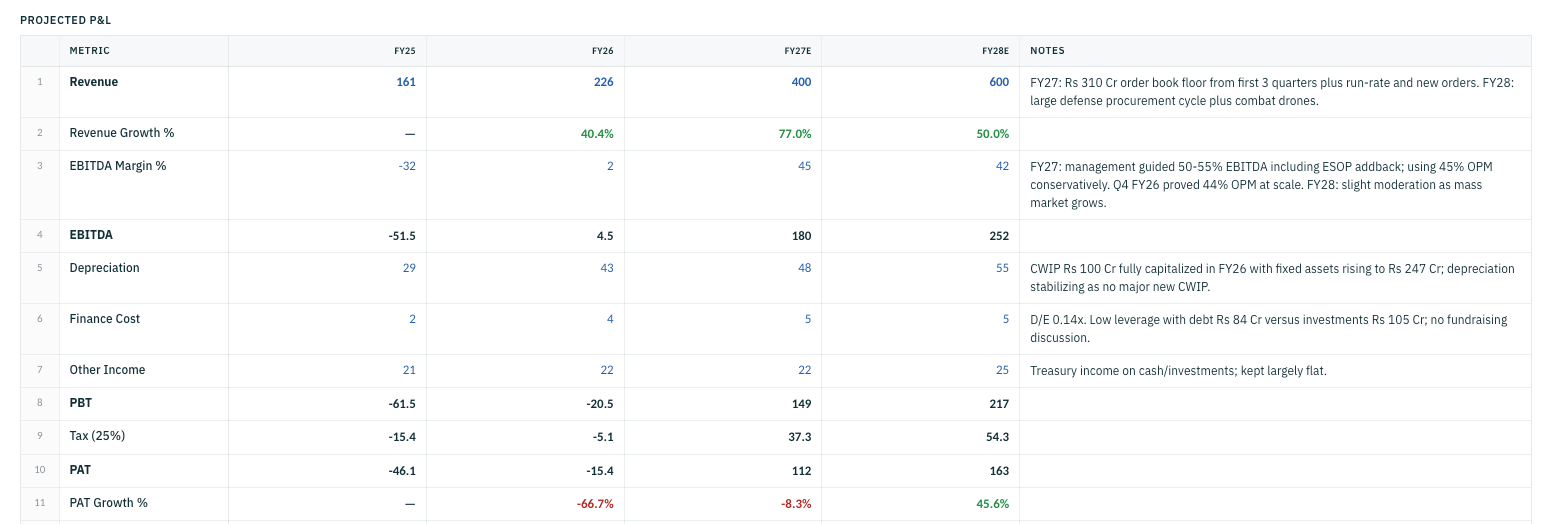
Bull Case
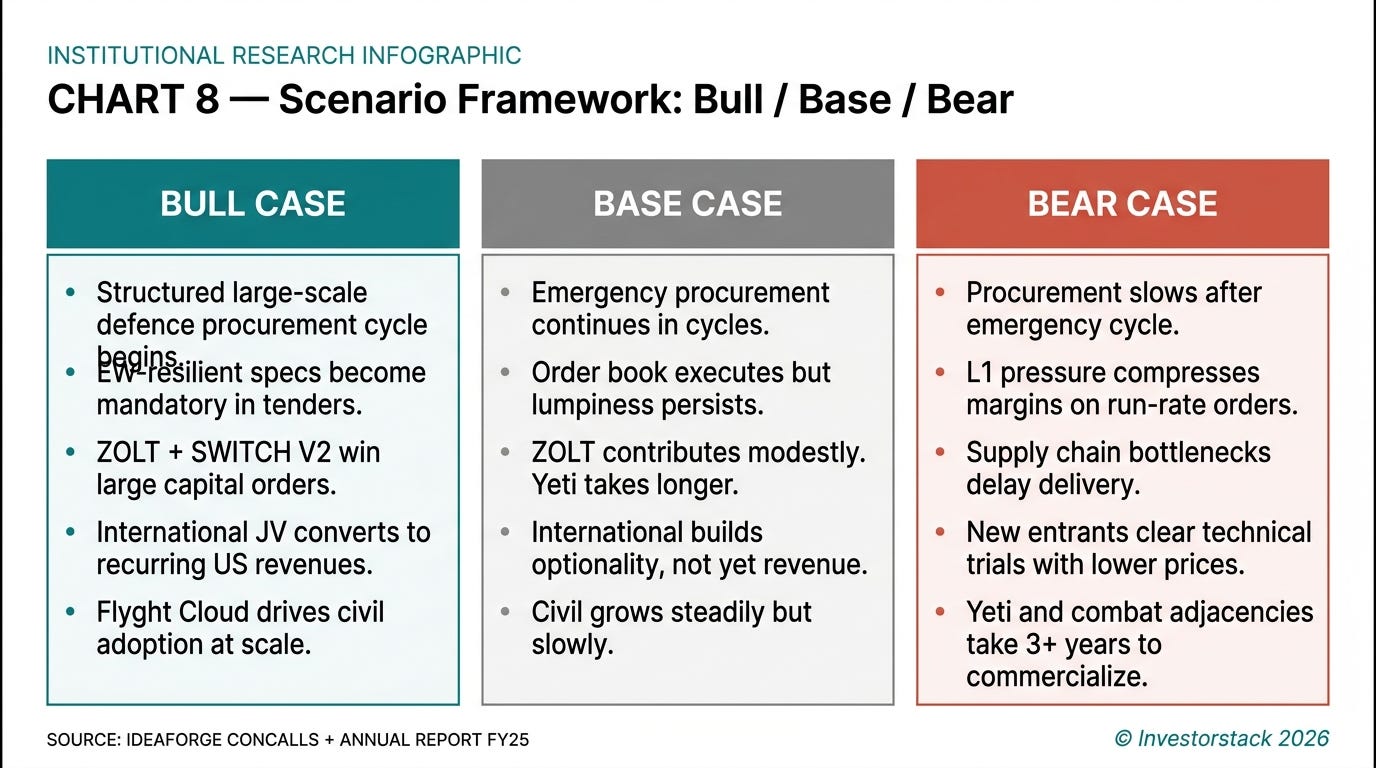
In the bull case, the Indian armed forces move from episodic emergency procurement to a larger, faster, structured drone acquisition cycle. Tenders require EW resilience, trusted supply chains, indigenous subsystems, and platforms that have already worked in harsh conditions. Ideaforge qualifies for more programs because the specifications increasingly match what it has been building for years.
ZOLT becomes a meaningful tactical platform, not only a development story. SWITCH v2, NETRA 5, and Q6 upgrades refresh the core portfolio. YETI proves its first high-altitude military logistics use case. Combat drone partnerships allow Ideaforge to participate in strike and loitering munition programs without becoming a munitions manufacturer itself.
Internationally, the first Breach joint venture gives the company a credible US operating base. Small orders become references. NATO training and stock numbers help open allied procurement conversations. Flyght Cloud and drone-as-a-service make civil customers adopt drones as a service rather than a capex decision. The business becomes less hostage to one tender cycle.
Base Case
In the base case, defence remains the main driver and remains lumpy. Ideaforge executes its carry-forward order book, wins some run-rate opportunities, and participates in larger tenders, but procurement timelines still slip. The company continues to be technically credible but has to live with inspection, acceptance, working capital, and bid timing friction.
ZOLT contributes, but not every tactical program converts quickly. YETI remains a longer-cycle development bet. Combat drone opportunities exist, but partnerships and customer requirements take time to settle. The US and Japan moves create optionality, but commercial orders build slowly.
Civil and enterprise adoption improves gradually. Flyght Cloud helps customers move from drone flights to usable workflows, but it does not instantly transform the business into a software company. Ideaforge remains a high-capability drone manufacturer with emerging software and service layers, not yet a smooth recurring-revenue platform.
Bear Case
In the bear case, procurement slows again after the emergency cycle. Tenders are delayed, capital procurement takes longer than expected, and smaller run-rate orders do not fill the gap. The company has invested ahead of demand in platforms, people, software, and international expansion, but revenue recognition depends on customer inspections and acceptance.
Competition becomes sharper. New entrants clear technical trials with lower prices. Tenders do not adequately reward enhanced performance. Customers buy enough capability rather than the best capability. Ideaforge’s technology edge remains real, but the L1 structure compresses its ability to capture value.
Supply-chain bottlenecks and technology shifts add pressure. Thermal imagers or trusted electronics become harder to source. Counter-drone systems evolve faster than expected. yeti and combat drone adjacencies take longer to commercialize. International opportunities demand localization and certification before scale. In this version, ideaforge remains strategically relevant but financially uneven because the market’s adoption curve is real but disorderly.
Thanks for reading! Do check out Investorstack.